Washington NASA Space Grant Consortium

UW’s AISES Chapter Soars in Wisconsin Space Grant’s First Nations Launch Challenge

Model Rockets
Model Rockets
First Nations Launch

It was, all things considered, perhaps not the best of launch conditions under which the UW’s chapter of the American Indian Science and Engineering Society (AISES) decided to go for the First Nations Launch challenge. Academic year 2020–2021 opened with the University of Washington still operating in remote instruction mode during the COVID-19 pandemic. Then, just before the end of the year, their National Association of Rocketry (NAR) mentor, WA Space Grant Director Robert Winglee, unexpectedly passed away.

But the UW AISES team persevered. Mike Harrell, lecturer in Earth and Space Sciences, stepped in as NAR mentor. And onward to Wisconsin the team went.

First Nations Launch (FNL), one of NASA’s Artemis Challenges, is a program of Wisconsin Space Grant. Founded in 2010, FNL supports tribal colleges and collegiate AISES chapters in building and strengthening their rocketry programs. The competition requires teams of undergraduate students to conceive, design, fabricate, and compete with high-power rockets. To date, undergraduate students from 24 U.S. and Canadian teams have participated, with more than 77 tribes represented.

2020–2021

The 2020–2021 team who, guided by team adviser Scott Pinkham, competed in the challenge was:

  • Cayenne Matt (physics; astronomy)
  • Charlie George (mechanical engineering)
  • Osvaldo Aldaz (aeronautics and astronautics)
  • Chyson Acoba (chemical engineering)

For their first attempt at FNL, the team’s goals were, as they told WI Space Grant in their team spotlight:

The team views this opportunity as a way to build a good foundation for interest and participation for the future of the UW AISES chapter. They hope to learn rocketry and system designs with hands-on-activities.

First Nations Launch Moon Challenge

The team entered the FNL Moon Challenge, where the goal is to “design, test, and fabricate specific structural design components (nosecone/shoulders, bulkheads/centering rings, fins, avionics sled) of a lightweight rocket from raw materials.” And how did these dedicated rocketeers fare? An impressive 2nd place overall in the Moon Challenge with a total score of 83.74 points! They also placed 3rd in written reports and 1st in oral reports. Finally, the Altitude Award also came home to UW with the team.

2021–2022

First Nations Launch Mars Engineering Challege

For their next FNL appearance, UW’s AISES team entered the Mars Engineering Challenge: “Teams shall design, test, and fabricate all structural components of a lightweight rocket from raw materials.”

The team continued to achieved high honors for their work, coming in 2nd place overall in the Mars Challenge and placing 3rd in written reports.

The 2021–2022 AISES rocketry team consisted of:

  • Charles George (electrical engineering)
  • Kiyoshi Oshiro (aeronautics and astronautics)
  • Osvaldo Aldaz (aeronautics and astronautics)
  • Isabel Ellison (pre-sciences)
  • Jea Heo (mechanical engineering)
  • Gage Santa Cruz (engineering)
  • James Tenorio (environmental engineering)

They were once again guided by Scott Pinkham, adviser, and Mike Harrell, NAR mentor.

Support from WA Space Grant

Washington NASA Space Grant Consortium has been very proud to support the UW’s AISES chapter as they build their rocketry team and compete in the First Nations Launch challenge. In autumn 2020, Director Winglee provided rocketry mentorship to the group. For the team’s journey to Wisconsin to compete in April 2022, WA Space Grant was able to provide travel support thanks to donations made to the Friends of WA Space Grant fund at the UW.

Sarah Tuttle, WA Space Grant Deputy Director, Featured in Scientific American

Sarah Tuttle and co.

Women have been astronomers since forever, but they have needed to be made of iron. Vera C. Rubin, who got her Ph.D. in 1954, was advised in school to stay away from science. She kept going anyway by telling herself she was just different from other people. She did her graduate studies where her husband’s job took them, raised children and then got a position where she was the only woman.

It has been more than half a century since Rubin attained her Ph.D. — we’re in a whole new millennium now. Has astronomy changed for the women in its ranks? Or have the women in its ranks changed astronomy?

In the April 2022 issue of Scientific American, Ann Finkbeiner profiled more than a dozen women who graduated with Ph.D.s in astronomy since 2000, including our own Sarah Tuttle, deputy director for science payloads and high altitude balloons.

Read the full article: Women Are Creating a New Culture for Astronomy. Scientific American; April 2022.

More Sarah Tuttle In the News

How naming the James Webb telescope turned into a fight over homophobia | The New York Times

December 28, 2022

For half a decade now, influential young scientists have denounced NASA’s decision to name its deep-space telescope after James E. Webb, who led the space agency to the cusp of the 1969 moon landing. Webb, critics insist, was a homophobe who oversaw a purge of gay employees. The controversy cuts to the core of who is worthy to memorialize and how past human accomplishment should be balanced with modern standards of social justice. Sarah Tuttle, assistant professor of astronomy at the UW, is mentioned.

Women are creating a new culture for astronomy | Scientific American

March 21, 2022

A new generation of scientists is challenging the biased, hierarchical status quo in astronomy. The UW’s Jessica Werk, associate professor of astronomy, and Sarah Tuttle, assistant professor of astronomy, are quoted.

James Webb Space Telescope launches into controversy | The Atlantic

October 25, 2021

The James Webb Space Telescope, the long-awaited successor to Hubble, is mired in controversy over its namesake. Sarah Tuttle, assistant professor of astronomy at the UW, is quoted.

The Webb telescope’s latest stumbling block: Its name | The New York Times

October 20, 2021

The long-awaited successor to the Hubble Space Telescope is scheduled to launch in December. But the NASA official for whom it is named has been accused of homophobia. Sarah Tuttle, assistant professor of astronomy at the UW, is quoted.

UW Scholar and Colleagues Tackle Plastic Recycling — and Take Top Honors in Environmental Innovation Challenge

2022 Catalytic Carbon Grand and Clean Energy Prize

Congratulations to Carter Vu, the UW’s current Astronaut Scholarship Foundation scholar, and the Catalytic Carbon team for snagging the $15,000 Alaska Airlines Grand Prize in the 2022 Alaska Airlines Environmental Innovation Challenge.

The team of aeronautics and astronomy, Master of Science in Entrepreneurship, and informatics students from the University of Washington utilizes a new recycling process that can quickly transform waste into carbon nanotubes and reusable hydrogen gas. They believe this solves an issue with current methods where only 9% of plastic is recycled correctly and over 75% ends up in landfills (according to the EPA).

Catalytic Carbon team
Carter Vu, center, and the Catalytic Carbon team. [Courtesy of the Foster School]

Vu, originally from Woodinville, has been a UW Space Grant Scholar since joining as a first-year student in 2018. For academic year 2020–2021, he was selected by the Astronaut Scholarship Foundation as their scholar at UW, an honor he successfully achieved again for the current academic year. Vu will graduate in June, after which he plans to pursue graduate studies in computational hypersonics at the University of Minnesota.


The annual Environmental Innovation Challenge is hosted by the UW Foster School’s Buerk Center for Entrepreneurship. Read their announcement for more about the challenge and the top teams.

In Space and On The Ground, Informatics Alum Has High Aspirations

Shannon Gatta
Shannon Gatta

By Jessi Loerch
Reposted courtesy of the iSchool.
Photo by Doug Parry for the UW iSchool.

Shannon Gatta’s work is out of this world.

Gatta, who graduated from the iSchool in 2020 with a degree in Informatics, works as a data engineer for the private aerospace company Blue Origin, has completed the first level of private astronaut training, and has interned at NASA’s Johnson Space Center and Langley Research Center.

She’s not content with fulfilling her own dreams; she’s using her talents to help other people — particularly those from marginalized groups — shoot for the stars as well.

Gatta first found a passion for space while at Seattle Central Community College. She had moved to Seattle from Texas after serving with the Army National Guard in Afghanistan, with a goal of transferring to the University of Washington. At Seattle Central, she heard about a rocketry club. It sounded cool and there was pizza, so she checked it out. It showed her a path forward she’d never expected.

“For me, it was a lot of large-scale topics I’d never really imagined for myself growing up in Texas,” she said. “It really surrounded me with a lot of goal-oriented people and helped me align with what my goals were going to be.”

While studying at Seattle Central, Gatta found opportunities to get involved at the UW, including aerospace-related research. By talking with advisors and students, she learned about Informatics and the iSchool, which sounded like the right fit for her. Before she even started at the iSchool, she was earning internships in her future field. She was working on flight software at NASA when she found out that she’d been accepted to the Informatics program.

Gatta settled into the iSchool quickly. Dowell Eugenio, an iSchool advisor, had suggested that she consider studying data science. When she enrolled, she took a class and liked it immediately.

“I loved that the class wasn’t just about the technology, it was about the responsibility that comes with knowing the data, and how you manipulate it and the power and accountability that comes along with the insight you provide,” she said.

As Gatta continued her studies, she was selected as an astronaut candidate for Out Astronaut and, in 2019, she completed the first phase of training. She’s still part of that program, which is seeking funding to send an openly queer astronaut into space. As a queer woman, it’s a goal that Gatta cares about deeply.

“That kind of visibility is important, not only for our own community but also for our capability to inspire the next generation,” she said. “We’re this invisible minority that has yet to be presented openly on such an international platform.”

Gatta was hired by Blue Origin right out of school. She now works as an aerospace data engineer on New Glenn, the largest payload capacity rocket ever created. Gatta’s work is creating a software platform that connects, tracks and interprets the immense amount of information that’s collected from the rocket’s many sensors. That information allows the rocket to adjust autonomously during launches, and it can help guide maintenance to allow quick turnarounds between launches. It also allows Blue Origin to closely analyze information to understand how the rocket will perform in different situations. For instance, how would it act differently lifting a heavy load of satellites versus a lighter load of humans?

Eugenio said Gatta stood out at the iSchool for her leadership and determination to be an advocate for others. He’s pleased that she found a job that made use of her many skills and interests.

“Shannon is sociable and friendly, passionate and caring. She was always a strong advocate for those who are marginalized,” he said. “She has a strong moral and ethical core in what she’s doing. She’s not going to be content with the status quo.”

As she thinks about the future, Gatta is thinking beyond her work. She’s focusing on helping other people in the field, particularly young women, minorities and members of the LGBTQ+ community. At Blue Origin, she the president of an LGBTQ+ organization of more than 150 employees. They’ve made important progress, including getting human resources to publish guidelines for people going through the process of gender transitioning.

“I think a lot of my goals now for the future are not so much career oriented, but about my volunteer work, and my job affords me that time,” she said. “When you’re in college, it’s always about what you create and what you do. Now that I’ve graduated, my life has centered around — what are you cultivating? What are you revisiting? Who are you helping?”

Huskies Stretch a Paw Toward Space

Paige
Paige

After five years, 25,000 hours, and work by dozens of students (from high school to graduate level), HuskySat-1 is in space. On Saturday, Nov. 2, a Northrop Grumman Cygnus resupply spacecraft launched from NASA’s Wallops Flight Facility in Virginia carrying HuskySat-1 among other science investigations and cargo. In January, the spacecraft will deploy its load of CubeSats, sending HuskySat-1 into orbit.

A CubeSat is a small satellite that measures exactly 10 centimeters (about 3 inches) along each side. HuskySat-1 is a “three-unit” system, meaning it’s the shape of a stack of three CubeSat-sized blocks. And students built all of it.

“Usually people buy most of the satellite and build one part of it. We built all the parts,” said Paige Northway, a doctoral student in Earth and Space Sciences. “It was a pretty serious undertaking.”

The camera setup on board was built with the help of students at the Raisbeck Aviation High School in the Highline School District.

The HuskySat project was funded both through Washington NASA Space Grant and via a NASA Undergraduate Student Instrument Project grant. WSGC Director Robert Winglee was at Wallops for the launch.

WSGC Director Robert Winglee took some video at Wallops shortly before HuskySat-1 launched into space aboard a Northrop Grumman resupply mission.

The launch was broadcast live on NASA TV and is available to rewatch on NASA’s YouTube channel.

HuskySat in the news

Several students from the Husky Satellite Lab were featured in local news coverage

“Now in space, a cutting-edge satellite the size of a shoebox, and UW students built it” — The Seattle Times, Nov. 11, 2019

Just be thankful there are students like Paige Northway and Nathan Wacker, two University of Washington students who think it’s neat to work on stuff like a satellite the size of a shoebox. For most of us, all that is beyond our comprehension. But that’s how things move forward in our high-tech age.

“Cygnus cargo ship heads to space station with satellite built by students in Seattle” — GeekWire, Nov. 2, 2019

Northrop Grumman launched a robotic Cygnus cargo capsule to the International Space Station today, marking one giant leap for a small satellite built by students at the University of Washington and Seattle’s Raisbeck Aviation High School.

“Washington students to make satellite history with HuskySat-1” — KOMONews, Oct. 31, 2019

Students are often told words of encouragement, such as “the sky is the limit.” These University of Washington students opted to shoot for the stars instead.

Washington’s first student-built satellite preparing for launch

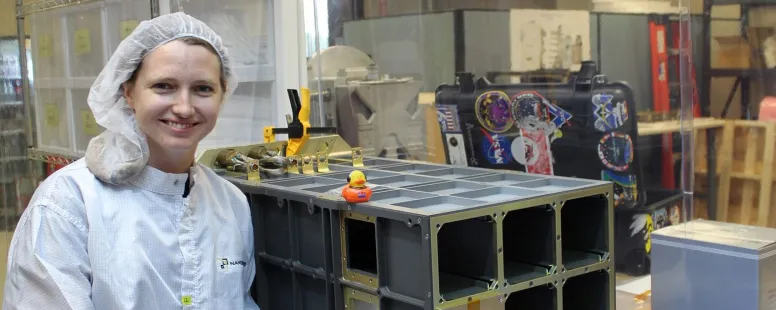
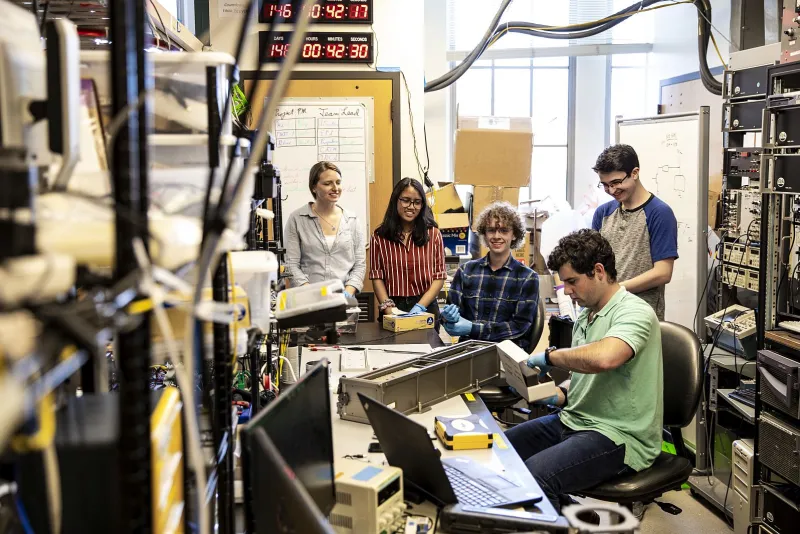
Team members Paige Northway, Anika Hidayat, John Correy and Eli Reed (back row, left to right) watch in June as Henry Martin of Nanoracks does a “fit test” to ensure that the satellite fits inside the silver box

Reprinted from UW News with permission.

Team members Paige Northway, Anika Hidayat, John Correy and Eli Reed (back row, left to right) watch in June as Henry Martin of Nanoracks does a “fit test” to ensure that the satellite fits inside the silver box

Team members Paige Northway, Anika Hidayat, John Correy and Eli Reed (back row, left to right) watch in June as Henry Martin of Nanoracks does a “fit test” to ensure that the satellite fits inside the silver box. The digital clock on the wall counts down the days, minutes and seconds until launch. Dennis Wise/University of Washington

A University of Washington satellite smaller than a loaf of bread will, if all goes well, launch this weekend on its way to low-Earth orbit. It will be the first student-built satellite from Washington state to go into space.

HuskySat-1 is one of seven student-built satellites from around the country scheduled to launch at 9:30 a.m. Eastern time Saturday, Nov. 2, from NASA’s Wallops Flight Facility on the Virginia coast.

HuskySat-1 sits under protection in the UW satellite lab in June, as it prepared to leave on its journey to Virginia and then to low-Earth orbit. Dennis Wise/University of Washington

HuskySat-1 sits under protection in the UW satellite lab in June, as it prepared to leave on its journey to Virginia and then to low-Earth orbit. Dennis Wise/University of Washington

“It will be exciting once it’s in orbit,” said Paige Northway, a UW doctoral student in Earth and Space Sciences who has been involved since the project’s inception. “To me, the completion will be when we can get data from the satellite and send instructions back.”

HuskySat-1’s last moments on Earth will be broadcast live on NASA TV. The satellites are hitching a ride on the Cygnus cargo spacecraft, whose first stop will be the International Space Station to resupply astronauts and swap out materials. In early 2020 the spacecraft will leave the station and fly up to an altitude of about 310 miles (500 kilometers), where a NASA engineer will eject the student-build satellites.

An earlier model of the satellite, shown here in the lab, had solar panels on wings that unfold.

An earlier model of the satellite, shown here in the lab, had solar panels on wings that unfold. The final model has solar panels attached on three sides to provide electrical power. Dennis Wise/University of Washington

The UW creation is a type of CubeSat, a small satellite that measures exactly 10 centimeters (about 3 inches) along each side. HuskySat-1 is a “three-unit” system, meaning it’s the shape of a stack of three CubeSat-sized blocks. These miniature satellites were first created as a way for engineering students to test software with smaller, cheaper devices they could build from start to finish in a few years. But the devices are growing in popularity, with Planet and other companies now using nanosatellites for commercial ventures.

NASA’s CubeSat Launch Initiative helps students and nonprofit groups launch these instrument systems into space. The Washington State University satellite, CougSat-1, is scheduled to launch in October 2020.

The UW satellite weighs just under 7 pounds (3.14 kilograms) and took five years to design and build. Undergraduate and graduate students from aeronautics and astronautics, mechanical engineering, computer engineering, Earth and space sciences, physics and other departments spent hundreds of hours building the system in the Husky Satellite Lab.

Its trip into low-Earth orbit is organized by Nanoracks, a Texas company that, like Spaceflight Industries of Seattle and other businesses, coordinates smaller groups to provide access to launch vehicles.

After extensive testing and final checkouts this summer, Northway hand-delivered the satellite in September to the Nanoracks facility in Houston, where it was placed into the box that will carry it to space.

“These students have gained firsthand experience on what is required to build and launch a satellite, and aerospace companies have already snapped up many of them,” said Robert Winglee, a professor of Earth and space sciences and the team’s faculty adviser as director of the UW Advanced Propulsion Lab. “Meanwhile, the UW is making its first steps to a continuing hardware presence in space. What more could you wish for?”

Three antennas installed on the roof of Johnson Hall will allow students to get information like position and altitude and send instructions to the satellite as it passes overhead. A camera built in collaboration with students at Raisbeck Aviation High School in Tukwila, Washington, will send back grainy, black-and-white photos of Earth. Students will also be able to control the satellite’s camera and thruster remotely.

“A lot of information is taught in classes, but only in a hands-on environment can you experience things like design, integration of subsystems, project management and documentation,” said team member Anika Hidayat, a senior in mechanical engineering.

HuskySat-1 will orbit at an angle of 51.6 degrees, traveling between 51.6 degrees north and south, at an altitude of 310 miles (500 kilometers) and at more than 4 miles (7 kilometers) per second. Once the students locate their satellite they will be able to predict its travel path.

Lines showing the satellite's projected path

White lines show the satellite’s projected travel path, orbiting at an angle of 51.6 degrees from the equator. The antennas at the UW will be able to communicate with HuskySat-1 when it flies inside the red circle. Paige Northway/University of Washington

Some of the student-built parts will still be in test mode. A custom-built thruster uses sparks to vaporize small amounts of solid sulfur as a propellant. The thruster will fire about 100 times as the satellite passes over Seattle, only enough thrust to provide a slight nudge. A high-bandwidth communications system built by former graduate student Paul Sturmer, now at Blue Origin, transmits at 24 Gigahertz, allowing the satellite to quickly send reams of data. That system will send down a test packet from space.

“Usually people buy most of the satellite and build one part of it. We built all the parts,” Northway said. “It was a pretty serious undertaking.”

The UW group will control HuskySat-1 for three months. In the spring it will transfer ownership and responsibility to AMSAT, the Radio Amateur Satellite Corporation, which provided the main communication system. The satellite will begin to lose altitude in about three years and will burn up as it re-enters Earth’s atmosphere. (NASA requires that all such objects deorbit within 25 years.)

HuskySat-1 grew out of a special topics course in the UW Department of Earth & Space Sciences. In 2016 members formed a registered student organization, the Husky Satellite Lab at UW.

“Being involved with this has taught me a lot,” said current team captain John Correy, a UW graduate student in aeronautics and astronautics. “But beyond that, it’s just validation that I’m in the right industry.”

As the Husky Satellite Lab wraps up this half-decade-long effort it plans to next tackle a NanoLab project — a partly prebuilt system that can be adapted to conduct experiments in microgravity — for travel aboard a Blue Origin vehicle. Students plan to complete that project by spring of 2020.

HuskySat-1 was supported by a NASA Undergraduate Student Instrument Project award, which funded the satellite’s development and launch with a private space contractor. The team also was supported by NASA, the Washington NASA Space Grant Consortium, the UW and several companies that provided equipment for the satellite and antenna.